

Hey there! As a supplier of CO2 3D laser engraving machines, I'm super stoked to share with you the working principle of these amazing pieces of tech. So, let's dive right in!
What's a CO2 3D Laser Engraving Machine?
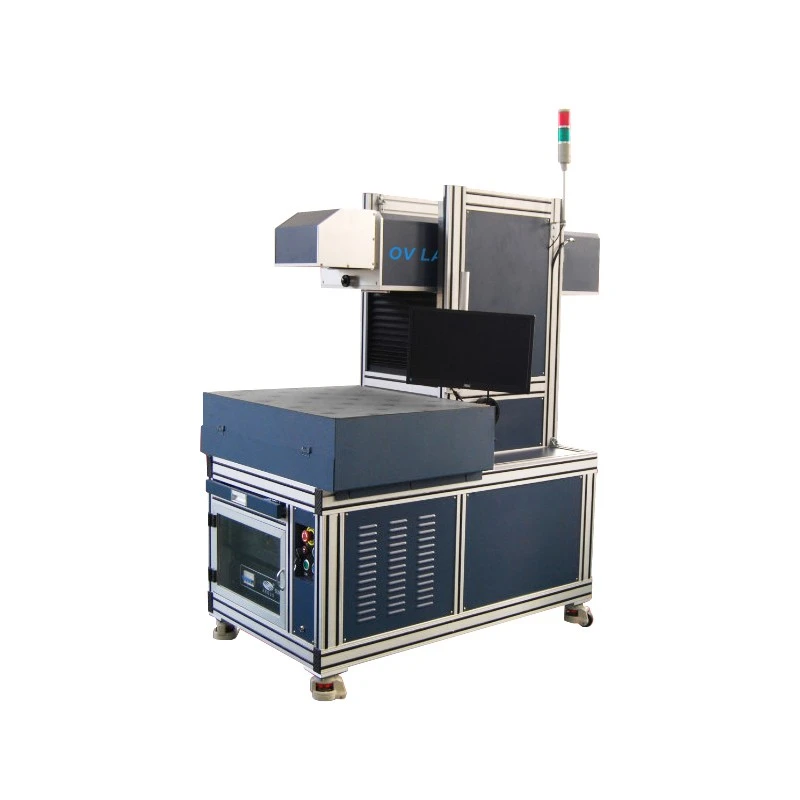
First off, a CO2 3D laser engraving machine is a powerful tool that uses a CO2 laser to etch or mark various materials in three - dimensional space. It's widely used in industries like advertising, handicrafts, and packaging. We offer different models such as the 3D Galvo CO2 Laser Marking Machine, 3D Dynamic CO2 Laser Marking Machine, and 3D Dynamic CO2 Laser Marking Cutting Machine.
The Basics of a CO2 Laser
The heart of a CO2 3D laser engraving machine is the CO2 laser. This laser is a gas laser that uses a mixture of carbon dioxide (CO2), nitrogen (N2), and helium (He) as the active medium. When an electrical current is applied to the gas mixture, it excites the CO2 molecules. As these excited molecules return to their normal state, they release photons, which form a coherent beam of light - that's our laser beam!
The CO2 laser typically emits light in the infrared region, with a wavelength of around 10.6 micrometers. This wavelength is well - absorbed by many materials, making it ideal for engraving and cutting.
The 3D Part: How It Works
Now, let's talk about the 3D aspect. In a 2D laser engraving machine, the laser beam moves across a flat surface to create the desired pattern. But in a 3D laser engraving machine, things get a bit more complex.
We use a combination of galvo scanners and a dynamic focusing system. Galvo scanners are high - speed mirrors that can quickly deflect the laser beam in two directions (X and Y). They're controlled by a computer, which tells them where to direct the laser beam to create the pattern.
The dynamic focusing system is what allows us to engrave in 3D. It adjusts the focus of the laser beam as it moves across the surface of the material. This is crucial because when engraving on a non - flat surface, the distance between the laser head and the material changes. The dynamic focusing system ensures that the laser beam remains focused at all points on the surface, resulting in a clear and consistent engraving.
The Engraving Process
So, how does the actual engraving happen? Once the laser beam is focused on the material, it delivers a high amount of energy in a short period. This energy heats up the material, causing it to vaporize or ablate. The vaporized material is then removed from the surface, leaving behind a permanent mark.
The depth and intensity of the engraving can be controlled by adjusting the power of the laser, the speed at which the laser beam moves, and the number of passes the laser makes over the same area. For example, if you want a deep engraving, you can increase the laser power and make multiple passes.
Material Compatibility
One of the great things about CO2 3D laser engraving machines is their wide range of material compatibility. They can engrave on materials like wood, acrylic, leather, glass, and some plastics. Different materials absorb the laser energy differently, so the settings on the machine need to be adjusted accordingly.
For instance, wood is a porous material that burns easily when exposed to the laser beam. So, we usually use a lower power and a faster speed to prevent the wood from catching fire. On the other hand, acrylic is a non - porous material that vaporizes cleanly, allowing for smooth and precise engravings.
Software and Control
To operate a CO2 3D laser engraving machine, you need software. The software is used to design the pattern that you want to engrave and to control the movement of the laser beam. It allows you to import files in various formats, such as DXF, AI, and PLT.
Once the design is loaded into the software, you can adjust the settings like laser power, speed, and number of passes. The software then sends the commands to the machine, which executes the engraving process.
Advantages of CO2 3D Laser Engraving Machines
There are several advantages to using a CO2 3D laser engraving machine. Firstly, they offer high precision. The laser beam can create very detailed and accurate patterns, even on small or complex surfaces.

Secondly, they're very efficient. The engraving process is fast, and you can engrave multiple items in a short period. This makes them suitable for mass production.
Thirdly, they're non - contact. Unlike traditional engraving methods that use physical tools, the laser beam doesn't touch the material. This means there's no wear and tear on the engraving tool, and there's less risk of damaging the material.
Maintenance and Safety
Like any piece of equipment, CO2 3D laser engraving machines require regular maintenance. The laser tube needs to be checked and replaced periodically, and the galvo scanners and other components need to be kept clean.
Safety is also a top priority. The laser beam can be very dangerous, so operators need to wear appropriate protective gear, such as laser - resistant goggles. The machine should also be installed in a well - ventilated area to remove the fumes generated during the engraving process.
Why Choose Our CO2 3D Laser Engraving Machines
As a supplier, we take pride in offering high - quality CO2 3D laser engraving machines. Our machines are built with the latest technology, ensuring precise and efficient engraving. We also provide excellent customer support, including installation, training, and after - sales service.
Whether you're a small business looking to add a personal touch to your products or a large - scale manufacturer in need of a reliable engraving solution, our machines can meet your needs.
Let's Talk Business
If you're interested in purchasing a CO2 3D laser engraving machine, I'd love to have a chat with you. We can discuss your specific requirements, the best model for your needs, and the pricing. Contact us, and let's start this exciting journey together!
References
- "Laser Technology Handbook" by John C. Ion
- "Industrial Laser Processing" by G. Chryssolouris and D. Maropoulos